

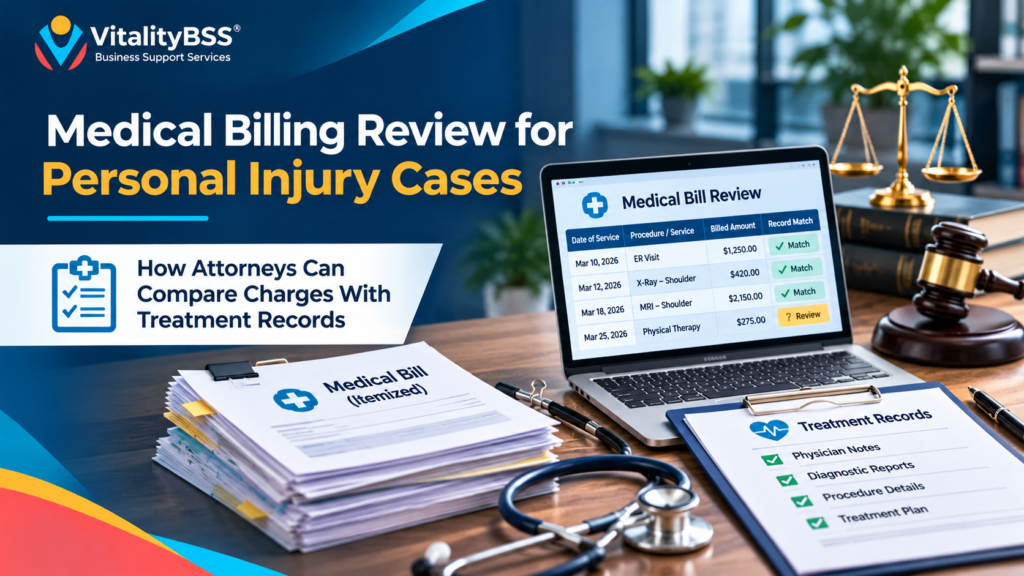
Medical bills are an important part of personal injury case documentation. They help show the healthcare services a claimant received and the charges associated with those services. But reviewing medical bills in isolation may not provide the complete picture.
Attorneys handling personal injury claims often work with itemized bills, hospital statements, physician invoices, diagnostic reports, treatment notes, and other supporting medical records. These documents need to be reviewed together to understand whether the billed services correspond with the documented treatment.
Medical Bill Review Services for Attorneys help legal teams organize billing information, compare charges with available treatment records, identify potential discrepancies, and prepare documentation for further review.
For example, an itemized bill may show a diagnostic procedure on a particular date. The corresponding medical records can help the legal team check whether the procedure is documented, which provider performed it, and whether the date and description appear consistent.
A difference does not automatically mean that a charge is incorrect. It may require clarification, additional documentation, or review by the appropriate billing or medical professional.
This guide explains how attorneys can compare medical bills with treatment records, identify entries that need attention, and organize billing documentation for personal injury cases.
Key Takeaways
- Compare bills with treatment records: Check dates of service, provider names, procedures, and supporting documentation.
- Review itemized charges: Examine individual service entries rather than relying only on the total amount shown on a statement.
- Look for duplicate entries: Identify repeated charges that may need confirmation before drawing conclusions.
- Check unexplained differences: Differences in dates, descriptions, providers, or amounts may require additional information.
- Do not assume every discrepancy is an error: Billing differences can have legitimate explanations, including separate services, adjustments, or corrected statements.
- Maintain source references: Keep billing entries connected to the original invoices and supporting medical records.
- Separate administrative findings from legal conclusions: A documentation review can flag questions, but it does not independently establish liability, medical necessity, or the reasonableness of a charge.
- Use organized review reports: Structured billing summaries can help attorneys identify items requiring follow-up.
- Consider professional review when needed: Complex coding, reimbursement, and clinical questions may require qualified billing or medical expertise.
What Is Medical Bill Review in Personal Injury Cases?
Medical bill review is the process of examining healthcare billing documents and comparing the information with relevant supporting records.
In a personal injury case, the review may involve hospital bills, physician charges, diagnostic services, emergency treatment, surgery, rehabilitation, prescription-related expenses, and other healthcare costs.
The purpose is to organize the billing information and identify whether the available documentation supports the details being reviewed.
A medical bill review assignment may include:
- Reviewing itemized medical bills
- Organizing billing statements by provider
- Checking dates of service
- Comparing billed procedures with treatment documentation
- Reviewing descriptions of services
- Identifying repeated or potentially duplicate entries
- Flagging unexplained differences
- Organizing supporting medical records
- Preparing billing review summaries
- Listing questions that require additional documentation
The scope depends on the firm’s requirements and the type of review requested.
Medical bill review should not be confused with a final determination of whether a charge is legally recoverable, medically necessary, or reasonable. Those questions may require additional legal, clinical, coding, or reimbursement expertise.
Why Should Attorneys Compare Medical Bills With Treatment Records?
An itemized bill provides information about the services a healthcare provider has charged for. Treatment records provide additional documentation about the patient’s care.
Reviewing both sources together can help legal teams understand the relationship between the billed services and the documented treatment.
For example, consider a personal injury claimant who received emergency treatment, diagnostic imaging, specialist consultations, and physical therapy.
The billing records may include separate charges from:
- The hospital
- The emergency physician
- The radiology provider
- The diagnostic imaging facility
- A specialist
- A physical therapy provider
These charges may appear in separate statements, even when the services relate to the same treatment episode.
By comparing the bills with the available medical records, the review team can organize the information and identify items that need clarification.
Benefits of Comparing Bills and Treatment Records
1. Better organization of medical expenses
Billing information can be arranged by date, provider, service type, or treatment episode.
2. Easier identification of missing documentation
A bill may refer to a service for which the corresponding supporting record has not been located in the available file.
This does not establish that the service was not performed. It indicates that additional documentation may be needed.
3. Identification of repeated entries
Similar charges appearing more than once can be flagged for review to determine whether they represent separate services, duplicate billing, or another explanation.
4. Clearer billing summaries
A structured report can help attorneys locate relevant charges without reviewing every invoice from the beginning.
5. Better follow-up with providers or billing departments
Specific questions can be prepared when information is missing, unclear, or inconsistent across documents.
How to Compare Itemized Medical Bills With Treatment Records
A useful medical billing review process follows a consistent sequence. Each billing entry should be examined against the available supporting documentation.
1. Match the Date of Service
The date of service is one of the first details to check.
Compare the date shown on the itemized bill with the date recorded in the corresponding medical documentation.
Relevant records may include:
- Emergency department notes
- Hospital admission records
- Discharge summaries
- Physician progress notes
- Diagnostic imaging reports
- Operative reports
- Physical therapy records
- Specialist consultation notes
For example, an invoice may list a diagnostic service on April 15, while the available imaging report is dated April 16.
This difference should be flagged for clarification. It does not automatically mean that either document is incorrect. The difference could relate to billing conventions, service timing, documentation dates, or another explanation.
What to check:
- Does the date of service match the supporting record?
- Is the billing date different from the treatment date?
- Does the invoice cover multiple dates?
- Is the service listed under an admission or treatment period?
- Is an explanation available for the difference?
2. Verify the Healthcare Provider
Medical bills may come from different providers involved in the same treatment episode.
For example, a hospital statement may cover facility services, while a separate physician group may bill for professional services.
Compare the provider information shown on the bill with the available records.
Check:
- Provider or facility name
- Physician name, where applicable
- Billing entity
- Treating department
- Service location
- Provider information shown in supporting documents
A different billing entity does not necessarily indicate an incorrect charge. Some healthcare organizations use separate billing entities for facility and professional services.
The purpose of this check is to understand who issued the charge and whether the available records help explain the service.
3. Match the Procedure or Service Description
The next step is to compare the billed procedure or service description with the treatment documentation.
An itemized bill may contain descriptions, procedure codes, revenue codes, or other billing information.
Supporting documents may include:
- Physician orders
- Diagnostic reports
- Operative notes
- Procedure notes
- Treatment summaries
- Discharge documentation
For example, a bill may contain a charge for a diagnostic imaging service. The review team can check whether the available records contain a corresponding imaging report or other documentation.
If the description is unclear or the documentation is incomplete, the item should be listed for further review.
Important: Matching a billed description with a medical record does not independently establish that the service was medically necessary, correctly coded, or reasonably priced. Those determinations may require additional professional review.
4. Compare the Quantity and Frequency of Services
Some treatment services may occur more than once.
Physical therapy, diagnostic testing, physician consultations, and other services can be provided across multiple visits.
A review should compare the quantity and frequency shown on the bill with the available treatment documentation.
For example, an itemized statement may list several physical therapy sessions. The supporting records may contain separate treatment notes for each visit.
Check:
- Number of visits billed
- Number of visits documented
- Dates associated with each service
- Repeated procedure descriptions
- Units or quantities shown on the invoice
- Whether the bill covers a defined treatment period
If the number of billed services differs from the number of located records, flag the difference for clarification.
Do not assume that the entries are duplicates simply because their descriptions are similar.
5. Check the Charges and Billing Details
After matching the service information, review the financial details.
Depending on the available documents, this may include:
- Charge per service
- Total line-item charges
- Quantity billed
- Adjustments
- Payments
- Insurance-related entries
- Outstanding balances
- Revised or corrected statements
Compare the amounts shown across related documents where possible.
For example, an original statement and a later corrected statement may show different totals. The review should identify the versions and determine which document appears to be the latest available statement.
The reason for an adjustment or difference should not be assumed without supporting information.
Common Medical Billing Differences Attorneys Should Review
Not every difference between a medical bill and a treatment record indicates an error.
Some differences may result from separate billing entities, documentation timing, corrected statements, billing adjustments, or the way services are described.
The goal is to identify questions that require clarification.
1. Duplicate or Repeated Entries
Duplicate entries are one area that may deserve closer examination.
For example, an itemized bill may show two similar charges for the same service on the same date.
Before treating them as duplicates, check:
- Whether the entries refer to the same service
- Whether the quantities are different
- Whether separate providers performed the services
- Whether one entry represents a facility charge and another a professional charge
- Whether the same service appears on multiple statements
- Whether one document is a revised version
Example: Two statements may show similar charges for a diagnostic procedure. One may represent the facility component and the other the interpreting physician’s professional service.
The entries should be examined before concluding that a duplicate charge exists.
2. Different Dates Across Billing and Treatment Records
A bill may show a different date from the corresponding treatment note or report.
Possible reasons include:
- Billing date versus service date
- Delayed documentation
- Multiple services during one admission
- Administrative processing
- Corrected or updated records
Record the difference and seek clarification when the available documentation does not explain it.
3. Different Provider Names
A medical bill may identify a billing group or facility rather than the individual healthcare professional listed in the treatment record.
This may happen when professional and facility services are billed separately.
Compare the available provider information and identify any relationship that requires confirmation.
4. Procedure Descriptions That Do Not Match Exactly
Billing descriptions and clinical documentation may use different terminology.
A medical record may describe a procedure in clinical language, while an invoice may use a billing description or code.
The reviewer should not assume that differently worded entries refer to different services.
Where necessary, the item should be flagged for review by someone with the appropriate coding or medical expertise.
5. Different Amounts Across Statements
Medical bills may change because of adjustments, payments, corrected invoices, or other billing activity.
Compare:
- Original statement
- Revised statement
- Itemized invoice
- Payment information
- Adjustment entries
- Current balance information
If the reason for a change is unclear, request clarification from the relevant billing department.
6. Charges Without Located Supporting Records
An itemized bill may list a service for which no corresponding report or treatment note appears in the file being reviewed.
This should be recorded as a documentation gap, not automatically classified as an unsupported or invalid charge.
Possible follow-up may include requesting:
- The missing procedure report
- Additional treatment notes
- A detailed itemized statement
- Provider clarification
- Corrected or supplemental documentation
Medical Bill Review Checklist for Personal Injury Attorneys
A standardized checklist helps legal teams review billing documents consistently across different cases.
| Review area | What to compare | Follow-up question |
|---|---|---|
| Date of service | Invoice date and treatment date | Is the difference explained? |
| Provider | Billing entity and treating provider | Are these separate billing entities? |
| Procedure | Billed service and supporting report | Is the corresponding documentation available? |
| Quantity | Number of services billed and documented | Do the quantities match? |
| Repeated entries | Similar descriptions, dates, and amounts | Are these separate services or possible duplicates? |
| Charges | Individual line items and totals | Is the amount explained by the available statement? |
| Adjustments | Original and revised statements | What caused the change? |
| Payments | Payments and remaining balances | Is the latest balance available? |
| Supporting records | Invoice and medical documentation | Is any supporting document missing? |
| Record version | Original and corrected documents | Which version should be used for review? |
Recommended Documentation Fields
For larger personal injury files, a structured review spreadsheet or report can include:
- Claimant or case ID
- Billing provider
- Date of service
- Invoice or statement reference
- Procedure or service description
- Billing code, where available
- Quantity
- Amount charged
- Supporting medical record
- Supporting page number
- Review observation
- Follow-up required
- Review status
This structure helps attorneys and their support teams track what has been reviewed and which items remain unresolved.
Questions Attorneys Should Ask When a Billing Difference Is Found
A review report should identify specific questions rather than make unsupported conclusions.
Depending on the discrepancy, useful follow-up questions may include:
Questions About Dates
- Does the invoice show the date the service was performed or the date it was billed?
- Is the service associated with an earlier or later treatment date?
- Is there an additional treatment record that has not been provided?
Questions About Providers
- Is the billing entity different from the treating provider?
- Does the invoice represent facility or professional services?
- Can the provider confirm which department or professional performed the service?
Questions About Procedures
- Is there a corresponding procedure report?
- Does the billed description refer to the same service documented in the treatment notes?
- Is additional coding or billing information needed to understand the entry?
Questions About Repeated Entries
- Do the entries refer to the same service?
- Were separate services performed?
- Are the charges from different billing entities?
- Is one statement a corrected or revised version?
Questions About Amounts
- Does the statement show adjustments or payments?
- Is the invoice an original or revised version?
- Can the billing department explain the difference between the statements?
- Is an updated itemized bill available?
These questions help create a clear follow-up process without treating every difference as an established billing error.
What Should a Medical Bill Review Report Include?
A useful medical bill review report should be easy for attorneys and legal support staff to understand.
It should organize the billing information and identify the supporting records used during the review.
Depending on the scope of the assignment, a report may include the following sections.
1. Case and Provider Information
- Case or claimant reference
- Healthcare provider name
- Billing entity
- Date range reviewed
- Documents received
2. Itemized Billing Summary
- Date of service
- Service description
- Quantity
- Amount charged
- Billing reference
- Provider information
3. Supporting Record References
- Medical record title
- Relevant treatment date
- Source document reference
- Page number
- Related procedure or service
4. Review Observations
The report may identify:
- Matching billing and treatment entries
- Repeated or potentially duplicate entries
- Date differences
- Provider information requiring clarification
- Missing supporting documentation
- Differences between statements
- Entries requiring additional review
5. Follow-Up Items
List the documents or explanations that may be needed to resolve outstanding questions.
For example:
| Review observation | Suggested follow-up |
|---|---|
| Bill lists a procedure, but the report was not located | Request the corresponding procedure report |
| Two similar charges appear on the same date | Confirm whether they represent separate services |
| Provider names differ | Confirm the billing relationship |
| Two statements show different totals | Request clarification about adjustments or revisions |
| Service dates differ | Confirm the actual date of service |
The report should distinguish between verified information, observations, and unresolved questions.
How Medical Bill Review Supports Personal Injury Case Preparation
Personal injury cases may involve multiple healthcare providers and substantial documentation.
An organized medical billing review can help legal teams navigate the financial documentation alongside the claimant’s treatment history.
1. Organizing Medical Expenses
Billing statements can be arranged by provider, treatment date, or service category.
This helps the team locate relevant financial records.
2. Connecting Charges With Treatment History
Comparing bills with treatment records can help identify the documentation associated with particular services.
3. Identifying Missing Information
The review may reveal that additional invoices, treatment notes, or billing explanations are needed.
4. Preparing Follow-Up Requests
Specific questions can be prepared for providers or billing departments instead of sending general requests for clarification.
5. Supporting Attorney Review
A structured summary can help attorneys identify relevant billing information and decide which issues require further investigation.
Medical bill review is a documentation support process. It does not independently determine liability, causation, admissibility, medical necessity, or the amount of damages recoverable in a case.
Medical Bill Review vs. Medical Record Review: What Is the Difference?
Medical bill review and medical record review are related but serve different purposes.
| Area | Medical bill review | Medical record review |
|---|---|---|
| Main focus | Billing information and charges | Patient treatment and medical documentation |
| Documents reviewed | Itemized bills, invoices, statements | Physician notes, hospital records, reports, and other medical documents |
| Main activity | Comparing billing entries with available supporting records | Organizing and examining treatment history |
| Key information | Dates, providers, procedures, quantities, and amounts | Diagnoses, treatment, procedures, and clinical events |
| Common output | Billing review summary and follow-up list | Medical chronology, summary, or organized record index |
| Main purpose | Understand and organize billing documentation | Understand and organize medical treatment documentation |
Both processes can work together.
For example, a medical chronology can help identify when a claimant received treatment, while a billing review can organize the charges associated with those services.
When used together, these documents provide a more organized view of the available medical and billing information.
How to Choose Medical Bill Review Services for Attorneys
When selecting a medical bill review provider, law firms should examine the provider’s process, experience, documentation standards, and ability to manage large record collections.
Consider the following factors.
1. Experience With Personal Injury Documentation
Ask whether the provider has experience handling hospital bills, physician invoices, diagnostic charges, and other medical billing documents associated with personal injury cases.
2. Ability to Compare Multiple Document Types
The provider should be able to work with itemized bills and relevant supporting medical records.
3. Source References
Ask whether observations can be linked to the original invoice and supporting record pages.
4. Duplicate and Difference Identification
Understand how repeated entries, date differences, and unexplained amounts are flagged.
5. Human Quality Checks
Ask who reviews the completed work and how errors or corrections are handled.
6. Data Security
Medical records contain sensitive information. Review the provider’s confidentiality arrangements, access controls, data retention, and secure document handling procedures.
7. Reporting Format
Confirm whether the provider can prepare reports in the firm’s preferred format, such as Excel, Word, or PDF.
8. Turnaround and Project Capacity
Ask how the provider handles multiple providers, large files, additional records, and urgent assignments.
9. Transparent Pricing
Understand whether pricing is based on pages, invoices, cases, or project scope. Confirm what is included and whether additional charges apply for revisions or complex documents.
10. Clear Scope of Work
Confirm whether the service covers document organization and comparison, coding review, fee analysis, or other specialized services. Do not assume that all these activities are included in a standard medical bill review assignment.
How VitalityBSS Supports Medical Records Review for Legal Teams
Vitality Business Support Services (VitalityBSS) provides medical documentation support for organizations handling complex medical records.
For law firms working on personal injury matters, organized billing and medical documentation can help make case files easier to navigate.
Relevant support services include:
- Medical record review
- Medical record indexing and organization
- Medical chronology preparation
- Medical record summarization
- Medical data abstraction
- Medical document sorting
- Bookmarking and tagging
- OCR and searchable document support
- Medical bill review support
Depending on the assignment, billing documents can be organized alongside available treatment records to help identify matching information and items that may require further clarification.
The review scope and final deliverables should be agreed upon in advance. Where specialized coding, clinical, reimbursement, or legal opinions are required, the appropriate qualified professional should perform that assessment.
Explore VitalityBSS Medical Records Review Services to learn more about our medical documentation support for legal teams.
Medical Records Review Services – https://vitalitybss.com/medical-records-review/
Frequently Asked Questions About Medical Bill Review Services for Attorneys
1. What are Medical Bill Review Services for Attorneys?
Medical Bill Review Services for Attorneys involve organizing and examining medical billing documents and comparing the information with available supporting records. The process may include checking dates, providers, procedures, quantities, charges, and differences that require clarification.
2. Why should personal injury attorneys review medical bills with treatment records?
Comparing medical bills with treatment records helps legal teams understand how billing entries relate to documented services. It can also help identify missing supporting documents, repeated entries, and differences that may need further investigation.
3. What documents are needed for medical bill review?
Common documents include itemized hospital bills, physician invoices, diagnostic service statements, treatment notes, procedure reports, discharge summaries, and payment or adjustment statements. The exact documents depend on the scope of the review.
4. How can attorneys identify duplicate medical billing entries?
Reviewers can compare service dates, provider names, procedure descriptions, quantities, billing references, and amounts. Similar entries should be examined before being classified as duplicates because separate providers or separate service components may generate similar charges.
5. Does a difference between a medical bill and a treatment record mean the bill is incorrect?
No. Differences may have legitimate explanations, including billing dates, separate billing entities, revised statements, or documentation timing. The difference should be recorded and clarified before drawing a conclusion.
6. Can medical bill review identify missing treatment documentation?
It can help identify billing entries for which corresponding supporting records have not been located in the available file. Additional documentation may then be requested from the relevant provider.
7. What is included in a medical bill review report?
Depending on the assignment, a report may include provider information, dates of service, service descriptions, quantities, charges, supporting record references, review observations, and follow-up questions.
8. Is medical bill review the same as medical record review?
No. Medical bill review focuses on billing documents and charges, while medical record review focuses on treatment documentation and medical history. Both processes can be used together to organize personal injury case records.
9. Can medical bill review determine whether a charge is reasonable or medically necessary?
A basic documentation comparison does not independently establish whether a charge is reasonable or medically necessary. Those questions may require specialized clinical, coding, reimbursement, or legal expertise.
10. Can law firms outsource medical bill review?
Law firms may engage external providers for defined medical documentation and billing review support. Before outsourcing, firms should confirm the provider’s experience, scope of work, quality checks, confidentiality arrangements, data security, and reporting requirements.
Final Thoughts
Medical billing review is an important part of organizing financial documentation in personal injury cases.
For attorneys, the goal is not simply to find differences between bills and treatment records. It is to understand which entries are supported by the available documentation, which items need clarification, and whether additional records are required.
Comparing dates of service, provider information, procedures, quantities, and itemized charges can help create a clearer billing record.
A structured review process also helps prevent assumptions. Similar entries may represent separate services, different billing entities, or revised statements rather than duplicate charges.
With organized medical bills, supporting records, and clearly documented follow-up questions, legal teams can work with a more complete view of the available case documentation.
Looking for medical documentation support for personal injury cases? Contact VitalityBSS to discuss your medical records review requirements.