

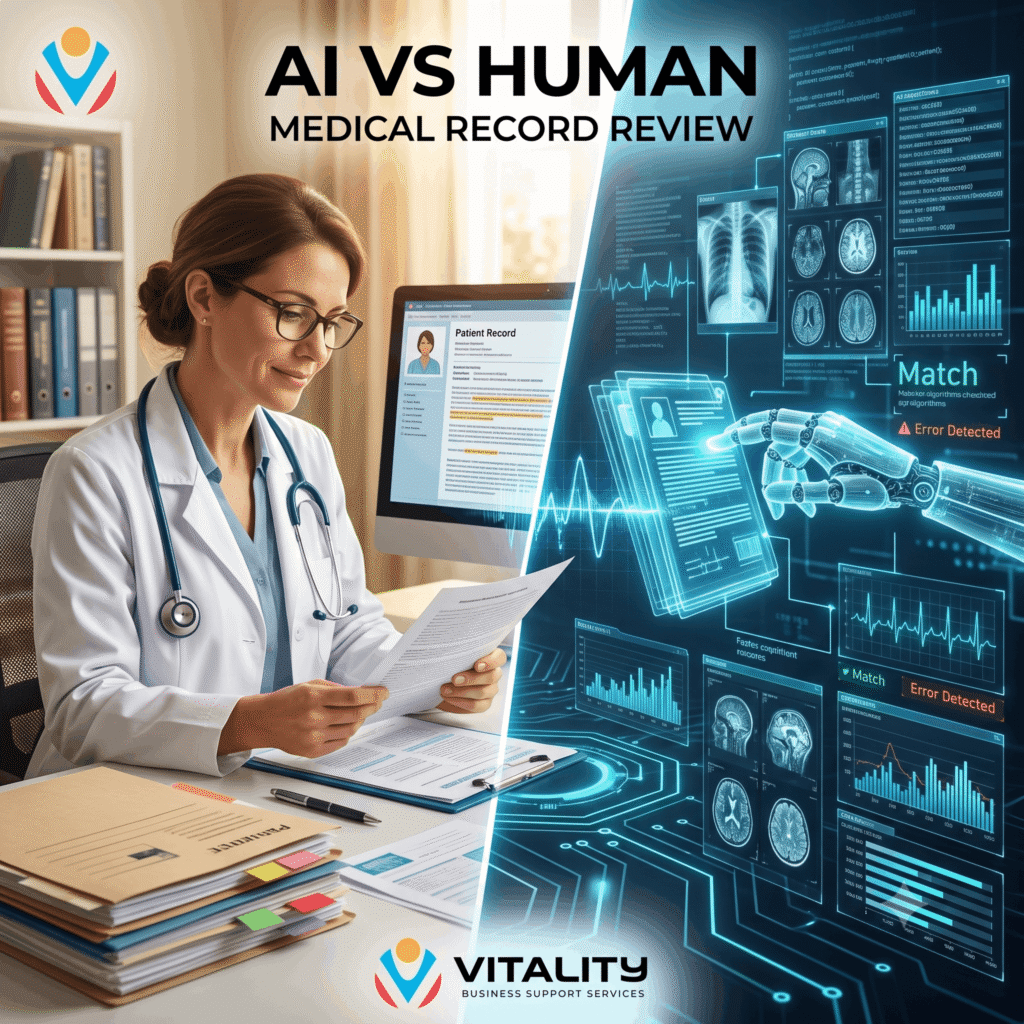
Key Takeaways
- AI can process large volumes of medical records quickly, helping with searching, extraction, organization, and preliminary summaries.
- Human reviewers provide context and judgment that automated systems may not consistently provide.
- AI-generated information should be verified against the original medical records before being relied upon for important legal or healthcare decisions.
- A human-in-the-loop approach can combine the speed of technology with human quality control.
- U.S. law firms can use technology-assisted medical record review for personal injury, medical malpractice, workers’ compensation, mass tort, and other cases.
AI vs Human Medical Record Review: Which Is Better?
Medical records have become increasingly large and complex. A single legal case can involve hospital records, physician notes, diagnostic reports, laboratory results, medication records, therapy notes, medical bills, and records from multiple healthcare providers.
Reviewing this information manually can take considerable time. At the same time, artificial intelligence (AI) is making it possible to process and extract information from large volumes of medical documentation much faster.
This raises an important question:
Can AI replace human medical record reviewers?
The short answer is not completely.
AI can help organize, search, extract, and summarize information from medical records. However, human reviewers remain important for understanding context, identifying relevant details, checking inconsistencies, and validating information against the original records.
For U.S. law firms, insurance organizations, healthcare organizations, and medico-legal teams, the most practical approach may be a combination of AI-assisted technology and human review.
What Is AI Medical Record Review?
AI medical record review uses artificial intelligence and related technologies to process medical documentation and identify specific information within large record sets.
Depending on the technology and workflow, AI can assist with tasks such as:
- Document classification
- OCR and text recognition
- Keyword and phrase searches
- Date extraction
- Diagnosis identification
- Medication identification
- Procedure identification
- Provider identification
- Data extraction
- Duplicate identification
- Preliminary medical summaries
- Preliminary medical chronologies
For example, an AI-assisted system may process thousands of pages and identify documents containing references to an injury, diagnosis, medication, surgery, or diagnostic test.
This can reduce the amount of repetitive searching required during the initial stages of a medical record review.
However, AI-generated information should be evaluated within the context of the complete record and the specific purpose of the review.
What Is Human Medical Record Review?
Human medical record review involves a trained reviewer examining medical documentation and identifying information relevant to the assignment.
A human reviewer may:
- Review medical records from multiple providers
- Understand the context surrounding medical events
- Identify relevant diagnoses and treatments
- Review medical histories
- Examine procedures and diagnostic results
- Identify gaps in documentation
- Compare information across different records
- Identify inconsistencies
- Prepare medical chronologies
- Prepare medical summaries
- Perform medical data abstraction
- Organize and index records
- Follow case-specific review instructions
Human review can be particularly useful when the records contain complex treatment histories or when the client needs information organized according to specific legal or case requirements.
AI vs Human Medical Record Review: What Is the Difference?
AI and human reviewers have different strengths.
| Factor | AI-Assisted Review | Human Review |
|---|---|---|
| Processing large volumes | Very strong | Strong |
| Document searching | Very fast | Fast |
| Data extraction | Strong | Strong |
| Repetitive tasks | Excellent | More time-consuming |
| Understanding context | Limited by system and data | Strong |
| Case-specific judgment | Limited | Strong |
| Identifying subtle inconsistencies | May require verification | Stronger |
| Preliminary summaries | Fast | More time-consuming |
| Quality control | Requires human validation | Human-led |
| Complex legal case requirements | Requires oversight | Better suited |
| Scalability | Very high | Depends on available resources |
The comparison is not simply about which one is “better.”
The more important question is:
Which parts of the medical record review process should be automated, and which require human oversight?
Can AI Replace Human Medical Record Review?
AI can automate or assist with many parts of medical record review, but it should not automatically be considered a complete replacement for human review.
Medical records contain more than isolated words and data points.
For example, a record may state that a patient received treatment for a particular condition. Understanding the significance of that information may require reviewing previous records, subsequent treatment, diagnostic findings, and the surrounding documentation.
A human reviewer can evaluate the information within that broader context.
AI can also produce incorrect or incomplete outputs. This is why important extracted information and summaries should be checked against the source documentation.
For legal and medico-legal matters, the consequences of overlooking an important record or misunderstanding the context can be significant.
Where Can AI Help in Medical Record Review?
AI can be particularly useful for repetitive and high-volume tasks.
1. Searching Large Medical Records
Instead of manually searching hundreds or thousands of pages, AI-assisted tools can help locate references to specific terms, dates, diagnoses, procedures, medications, or providers.
2. Extracting Information
AI can assist in extracting structured information from unstructured medical documentation.
For example, a system may identify:
- Patient information
- Dates
- Provider names
- Diagnoses
- Procedures
- Medications
- Test results
The extracted information should still be reviewed for accuracy when it is being used for an important case or deliverable.
3. Organizing Documents
AI-assisted technology can help classify and organize large numbers of documents based on their content.
4. Creating Preliminary Summaries
AI can help create an initial summary of information contained within a large collection of records.
A human reviewer can then check the summary against the original documentation and make necessary corrections.
5. Identifying Potentially Relevant Records
AI can help flag documents that may contain information relevant to a particular case or review requirement.
This can help human reviewers focus their attention on potentially important sections.
Where Is Human Medical Record Review Still Important?
Human review becomes particularly valuable when the assignment requires context, judgment, and verification.
Understanding Medical Context
A diagnosis or procedure should not always be viewed in isolation.
The surrounding records may provide information that changes how the event should be understood.
Identifying Missing Information
A later medical note may refer to an earlier test, consultation, or treatment that is not included in the available record set.
A human reviewer may identify this type of documentation gap while reviewing the overall timeline.
Reviewing Inconsistencies
Medical records may be created by different providers at different times.
Dates, diagnoses, medications, or descriptions may sometimes differ between documents.
A human reviewer can flag these differences for further review.
Following Case-Specific Instructions
A law firm may not want a general summary.
For example, an attorney may request information specifically related to:
- A particular injury
- A specific body part
- A specific date range
- A particular provider
- Prior medical history
- Treatment after an accident
Human review can be structured around these specific requirements.
AI vs Human Medical Chronology
Medical chronology is one area where AI can provide useful assistance but human verification remains important.
AI can identify dates and medical events from large numbers of documents and use them to create a preliminary timeline.
For example:
January 5: Emergency department visit
January 12: Primary care follow-up
January 20: MRI performed
February 3: Specialist consultation
February 15: Physical therapy begins
However, a medical chronology is not simply a list of dates.
The reviewer may need to determine:
- Which events are relevant
- Whether multiple records refer to the same event
- Whether an event is missing supporting documentation
- Whether information conflicts between records
- How the events relate to the requested scope of review
This is why human verification can be an important part of an AI-assisted chronology workflow.
Is AI Medical Record Review Accurate?
There is no single accuracy rate that applies to every AI medical record review system.
Accuracy can depend on:
- The AI technology being used
- Quality of the source records
- Whether documents are scanned or digital
- Medical terminology
- Record complexity
- The type of information being extracted
- The instructions provided to the system
- Human quality control
For this reason, organizations should not assume that every AI-generated summary or extracted data point is automatically correct.
Important information should be checked against the original medical documentation.
This is especially important when medical record review is being used for litigation, claims, or other matters where accuracy and documentation are important.
What Is the Best Approach: AI or Human Review?
For many organizations, the best approach is not choosing between AI and human review.
It is using AI-assisted technology with human oversight.
A typical workflow could look like this:
Medical records received
↓
AI-assisted document processing
↓
Information extraction and organization
↓
Preliminary chronology or summary
↓
Human review and verification
↓
Quality check
↓
Final deliverable
This approach allows technology to handle repetitive, high-volume tasks while human reviewers focus on context, accuracy, case requirements, and quality control.
Benefits of a Human-in-the-Loop Medical Record Review Process
A human-in-the-loop approach combines technology with human review.
Faster Initial Processing
AI can help process large record sets and identify potentially relevant information quickly.
Human Quality Control
A reviewer can check extracted information against the original records.
Better Handling of Complex Records
Human reviewers can examine information that requires context or comparison across multiple documents.
Scalable Workflows
Technology can assist with large volumes of records while human reviewers provide oversight.
Case-Specific Review
The final review can follow the specific requirements of the attorney, law firm, insurer, or other client.
AI vs Human Medical Record Review for U.S. Law Firms
U.S. law firms may work with medical records in a variety of cases, including:
- Personal injury
- Medical malpractice
- Workers’ compensation
- Mass tort
- Product liability
- Disability claims
- Insurance claims
- Other litigation matters
The volume of records can vary significantly from one case to another.
A smaller case may involve records from only one or two providers, while a complex litigation matter may involve records from multiple hospitals, physicians, specialists, diagnostic centers, and other providers.
AI-assisted tools can help with high-volume processing, while human reviewers can provide case-specific review and verification.
The appropriate workflow depends on the type of case, volume of records, review objectives, and required deliverables.
Can Law Firms Outsource AI-Assisted Medical Record Review?
Yes.
U.S. law firms can work with medical record review service providers that use technology-assisted workflows to support medical record organization, extraction, chronology, summarization, and other review tasks.
Before outsourcing, law firms should understand:
- What technology is being used
- What information is processed automatically
- Where human review is involved
- How outputs are verified
- How medical records are protected
- How confidential information is handled
- What deliverables will be provided
When protected health information is involved, organizations should also consider applicable privacy, security, and contractual requirements.
AI and HIPAA: What Should U.S. Organizations Consider?
Medical records may contain protected health information (PHI).
When HIPAA applies, organizations should understand how PHI is collected, accessed, processed, stored, and shared.
The U.S. Department of Health and Human Services explains that business associate requirements can apply when certain organizations perform services involving protected health information on behalf of covered entities. Applicable arrangements may include a Business Associate Agreement (BAA).
Therefore, organizations considering AI-assisted medical record review should ask questions such as:
- Is PHI being processed?
- Where is the data processed?
- Who can access it?
- How is the information protected?
- Is a Business Associate Agreement required?
- How long is the information retained?
- How is information deleted after the project?
The exact requirements depend on the organizations involved and the nature of the services.
AI vs Human Medical Record Review: Which Is Better?
There is no universal answer.
AI is better suited to speed, automation, searching, extraction, and handling repetitive tasks.
Human reviewers are better suited to context, judgment, verification, case-specific requirements, and quality control.
For complex medical record review, combining both can provide a practical balance.
The goal should not be to replace human review simply because AI is available.
The goal should be to use technology where it adds value while keeping appropriate human oversight where accuracy and context matter.
How VitalityBSS Supports Medical Record Review
Vitality Business Support Services provides medical record review support for U.S. organizations that work with large volumes of medical documentation.
Our services can include:
- Medical record review
- Medical chronology
- Medical record summarization
- Medical data abstraction
- Medical record indexing
- Record sorting and organization
- Bookmarking and tagging
- OCR and searchable records
- Medical bill review
- IME transcription
- Case report preparation
- Medical record retrieval
- Workers’ compensation support
For organizations exploring technology-assisted review, the workflow can be structured around the specific requirements of the project, including record volume, review scope, required deliverables, and quality-control needs.
The objective is simple: make large medical record sets easier to organize, review, and use.
Frequently Asked Questions
Can AI replace human medical record reviewers?
AI can assist with many medical record review tasks, but it should not automatically be considered a complete replacement for human reviewers. Human oversight can be important for context, verification, inconsistencies, and case-specific requirements.
Is AI better than humans for medical record review?
AI is generally better suited to high-volume processing, searching, extraction, and repetitive tasks. Human reviewers are better suited to contextual understanding, judgment, verification, and complex case requirements.
What are the advantages of AI medical record review?
AI can help process large volumes of records, search documents quickly, extract information, classify documents, and create preliminary summaries or chronologies.
What are the limitations of AI medical record review?
AI can produce incomplete or incorrect results and may not consistently understand the context or significance of information in complex medical records. Human verification may therefore be necessary.
Can AI create a medical chronology?
Yes. AI can assist with identifying dates and medical events and creating a preliminary chronology. Human review can then be used to verify the timeline against the original records.
Should AI-generated medical summaries be reviewed by a human?
For important legal, claims, or medico-legal work, AI-generated summaries should be checked against the source documentation to identify potential errors, omissions, or contextual issues.
Can law firms outsource AI-assisted medical record review?
Yes. U.S. law firms can outsource medical record review and related services to specialized providers. The scope of technology use and human review should be clearly defined before the project begins.
Is AI medical record review suitable for personal injury cases?
AI can assist with processing and organizing records in personal injury cases, particularly when record volumes are large. Human review can help verify information and ensure that the review follows the requirements of the case.
What is a human-in-the-loop medical record review?
A human-in-the-loop workflow combines automated technology with human review. AI may assist with processing and extracting information, while a human reviewer verifies the information and handles areas requiring context or judgment.
Final Thoughts
AI is changing how medical records can be processed and reviewed, but the technology does not eliminate the need for human oversight.
The future of medical record review is not necessarily AI versus humans. It is AI working with humans.
AI can help process large amounts of information quickly. Human reviewers can provide context, verification, quality control, and case-specific judgment.
For U.S. law firms and organizations dealing with complex medical documentation, a technology-assisted, human-reviewed approach can provide a practical way to manage large record volumes while maintaining a review process focused on accuracy and the requirements of each case.