

Key Takeaways
- Medical record review involves examining and organizing medical documentation to identify information relevant to a case or claim.
- U.S. law firms may use medical record review for personal injury, medical malpractice, workers’ compensation, mass tort, and other litigation matters.
- A review can include medical chronology, summarization, indexing, data abstraction, record organization, bookmarking, and identification of missing information.
- Medical record review and medical chronology are related but different. A chronology is generally one type of output from a broader review.
- U.S. organizations can outsource medical record review when they need additional review capacity or regularly handle large medical files.
- When protected health information is handled by a HIPAA-regulated covered entity’s business associate, applicable HIPAA requirements and contractual safeguards should be considered.
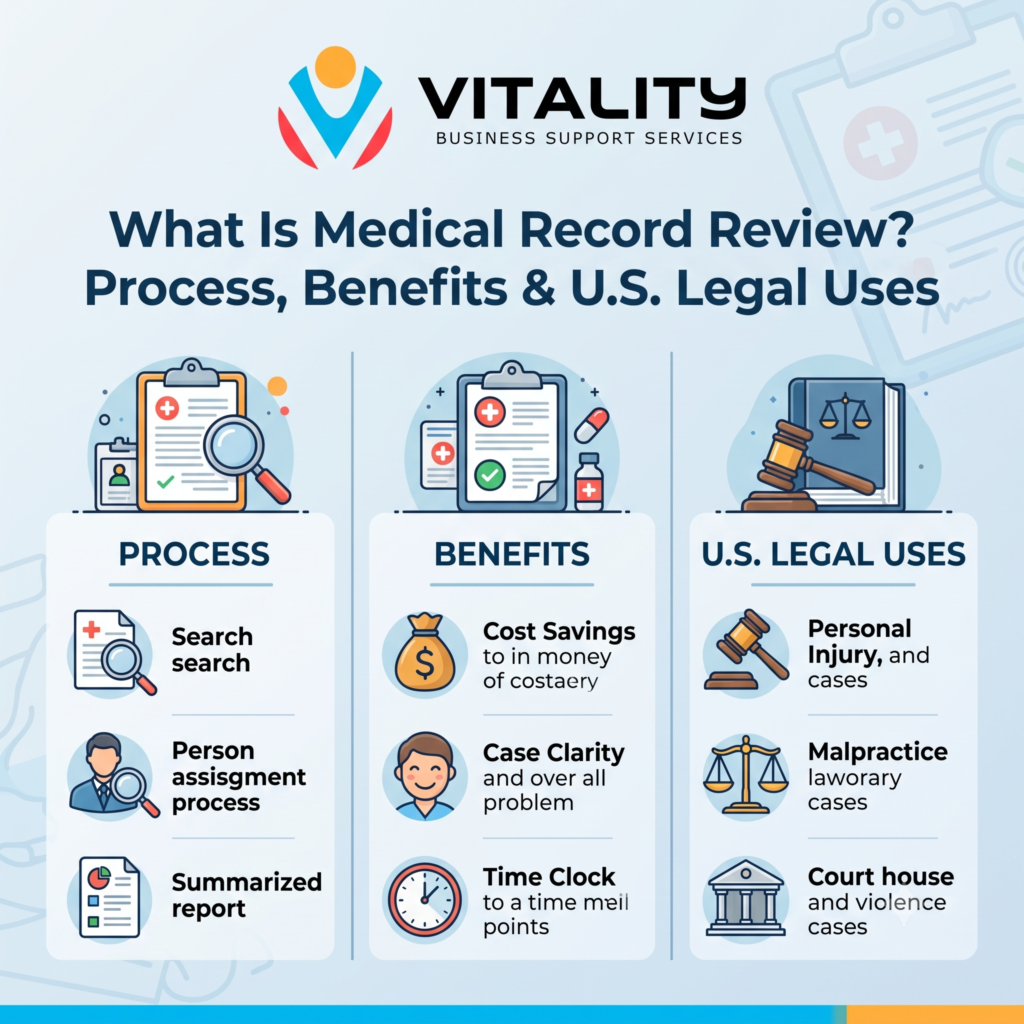
What Is Medical Record Review? Process, Benefits & U.S. Legal Uses
Medical records can become one of the most important sources of information in a personal injury claim, medical malpractice case, workers’ compensation matter, disability claim, or other legal proceeding.
A single case may contain records from emergency departments, hospitals, primary care physicians, specialists, imaging centers, physical therapists, pharmacies, laboratories, and other healthcare providers.
Reviewing hundreds or thousands of pages manually can take significant time.
Medical record review is the process of examining, organizing, analyzing, and summarizing medical records to identify information relevant to a specific case, claim, or legal matter.
For U.S. law firms, attorneys, insurance professionals, and medico-legal organizations, medical record review can help turn large volumes of medical documentation into an organized and easier-to-review format.
This guide explains what medical record review is, what a medical record reviewer does, how the review process works, what is included, how medical record review differs from a medical chronology, and how U.S. organizations can outsource medical record review services.
What Is Medical Record Review?
Medical record review is the systematic examination of a patient’s medical records to identify, organize, extract, and summarize information relevant to a particular purpose.
In a legal case, the purpose may be to understand the patient’s medical history, treatment after an accident, prior conditions, diagnostic findings, procedures, medications, follow-up care, or other information relevant to the matter.
Medical records may include:
- Emergency room records
- Hospital records
- Physician progress notes
- Specialist notes
- Diagnostic reports
- Laboratory results
- Imaging reports
- Operative reports
- Physical therapy records
- Medication records
- Medical bills
- Discharge summaries
- Insurance-related documentation
- Other healthcare records
The exact scope depends on the case and the instructions provided by the client.
For U.S. litigation teams, organized medical records can make it easier to locate important dates, treatment events, documentation gaps, and other relevant information.
The American Bar Association has noted that medical chronology work can help legal teams identify missing, illegible, or questionable records and understand large volumes of medical information.
What Does a Medical Record Reviewer Do?
A medical record reviewer examines the available documentation according to the requirements of the assignment.
Depending on the case, the reviewer may:
- Review medical records from multiple providers
- Organize records by date or provider
- Identify important medical events
- Extract diagnoses
- Review treatment history
- Identify procedures and surgeries
- Review diagnostic tests and results
- Review medication history
- Identify hospitalizations
- Identify gaps in available documentation
- Identify inconsistencies within the records
- Prepare medical chronologies
- Prepare medical summaries
- Perform medical data abstraction
- Index records
- Bookmark important sections
- Tag relevant documents
- Prepare case reports
- Review medical bills when requested
The reviewer works from the documentation provided and presents the information in the format requested by the client.
A medical record reviewer does not automatically provide a medical diagnosis or legal conclusion simply because they are reviewing medical records. The scope of the work should be clearly defined according to the assignment.
Why Is Medical Record Review Important for U.S. Law Firms?
Medical records can contain a large amount of information that may be relevant to a legal matter.
For example, a personal injury case may involve records from:
- Emergency departments
- Primary care providers
- Orthopedic specialists
- Neurologists
- Radiologists
- Physical therapists
- Pain management providers
- Hospitals
- Pharmacies
Without organization, finding a specific event or treatment detail may require reviewing the same records multiple times.
A structured medical record review can help attorneys and legal teams understand:
- What happened after an injury
- When treatment occurred
- Which providers treated the patient
- What diagnoses were documented
- What procedures were performed
- What diagnostic tests were conducted
- Whether treatment continued over time
- Whether there are gaps in the available records
- Whether prior or subsequent medical events appear in the documentation
The ABA has also highlighted the value of reviewing medical records for completeness, consistency, relevance, and privacy-related issues before records are used in litigation.
What Is Included in Medical Record Review?
The scope can vary from one case to another. Common components include the following.
Medical Record Organization
Records received from multiple providers can be organized into a logical structure.
This may involve sorting documents by:
- Date
- Provider
- Facility
- Record type
- Treatment episode
- Case requirement
Medical Record Indexing
An index provides a quick reference to the contents of a medical record.
It may include:
- Date
- Provider
- Facility
- Document type
- Page number
- Description
An organized index can help attorneys and other reviewers locate documents faster.
Medical Chronology
Medical events can be arranged chronologically to show the sequence of treatment.
For example:
January 8, 2026: Emergency department visit
January 15, 2026: Orthopedic consultation
January 22, 2026: MRI performed
February 3, 2026: Follow-up appointment
February 17, 2026: Physical therapy begins
A chronology can provide a quick overview of the documented treatment timeline.
Medical Record Summary
A medical summary condenses relevant information from the records.
Depending on the assignment, it may cover:
- Medical history
- Injury or condition
- Symptoms
- Diagnoses
- Treatment
- Procedures
- Diagnostic findings
- Medications
- Hospitalizations
- Follow-up care
Medical Data Abstraction
Data abstraction involves extracting specific information from medical records according to predefined requirements.
The information may include diagnoses, procedures, dates, medications, test results, provider information, or other case-specific data.
Identification of Missing Records
During a review, the records may refer to a document, provider, test, or treatment event that is not included in the available file.
These gaps can be flagged for further investigation.
Identification of Inconsistencies
Records created by different providers may contain differences in dates, descriptions, diagnoses, medications, or other information.
Relevant inconsistencies can be identified and presented for further review.
Bookmarking and Tagging
Important sections can be bookmarked or tagged to make large medical files easier to navigate.
OCR and Searchable Records
Scanned medical documents may be processed using OCR technology to make text easier to search.
This can help reviewers locate names, dates, diagnoses, medications, procedures, and other terms in large files.
How Does the Medical Record Review Process Work?
A typical U.S. medical record review workflow can include the following steps.
Step 1: Receive the Records
The medical records are received from the client or an authorized source.
The files may contain documentation from one or multiple healthcare providers.
Step 2: Review the Assignment
The reviewer identifies the purpose and scope of the review.
For example, the client may request a complete chronology or may only require information related to a specific injury, date range, diagnosis, or treatment.
Step 3: Organize the Records
The documents are sorted and arranged according to the project requirements.
Duplicate records may also be identified during this stage.
Step 4: Review the Documentation
The reviewer examines the records and identifies information relevant to the assignment.
This can include diagnoses, symptoms, treatment, procedures, test results, medications, hospitalizations, and follow-up visits.
Step 5: Extract Relevant Information
Important information is extracted and organized.
The format depends on the requested deliverable.
Step 6: Prepare the Deliverable
The reviewer may prepare:
- Medical chronology
- Medical summary
- Medical record index
- Medical abstraction
- Case report
- Medical record analysis
- Other client-specific documentation
Step 7: Quality Review
The completed work is checked for consistency, completeness, formatting, and alignment with the assignment requirements.
Step 8: Deliver the Completed Review
The final work is delivered in the agreed format for use by the client.
What Is the Difference Between Medical Record Review and Medical Chronology?
These terms are sometimes used interchangeably, but they describe different things.
Medical record review is the broader process of examining and organizing medical documentation.
Medical chronology is a structured timeline of relevant medical events.
| Medical Record Review | Medical Chronology |
|---|---|
| Broader review process | Specific type of deliverable |
| Examines medical documentation | Organizes events by date |
| Can include indexing and abstraction | Focuses on the treatment timeline |
| Can include summaries | Presents important medical events |
| May identify missing information | Can highlight gaps in the timeline |
A medical chronology can therefore be one of the outputs produced during a medical record review.
What Types of U.S. Cases Use Medical Record Review?
Medical record review can be used across different U.S. legal, insurance, and healthcare-related matters.
Personal Injury Cases
Personal injury claims may involve substantial medical documentation following an accident or injury.
Review may focus on:
- Initial treatment
- Diagnosis
- Medical procedures
- Imaging
- Rehabilitation
- Follow-up treatment
- Prior medical history
- Subsequent injuries
Medical Malpractice Cases
Medical malpractice matters can involve records from multiple providers and facilities.
A structured review can help organize the documented treatment history for further legal and medical evaluation.
Workers’ Compensation Claims
Workers’ compensation cases may require review of records relating to workplace injuries, treatment, rehabilitation, restrictions, and return-to-work documentation.
Mass Tort and Product Liability Cases
Large litigation matters can involve substantial numbers of medical records.
Consistent review and abstraction processes can help legal teams manage information across cases.
Disability Claims
Medical documentation may be reviewed to organize treatment history, diagnoses, functional information, and other records relevant to a disability claim.
Insurance and Claims Review
Insurance organizations and claims professionals may use medical record review to examine documentation relevant to claims and related processes.
Who Uses Medical Record Review Services in the United States?
Common users include:
- Personal injury law firms
- Plaintiff attorneys
- Defense attorneys
- Workers’ compensation law firms
- Medical malpractice law firms
- Insurance companies
- Claims professionals
- Medico-legal organizations
- Healthcare organizations
- Litigation support teams
- Legal support service providers
The specific requirements differ depending on the type of organization and case.
What Are the Benefits of Outsourcing Medical Record Review?
U.S. organizations that handle large volumes of medical documentation may choose to outsource some or all of their record review work.
Potential operational benefits include:
Additional Review Capacity
An external team can provide additional resources when internal teams have a high volume of cases.
Less Manual Review Work
Organized summaries and chronologies can reduce the need to repeatedly search through large record sets.
Support for Large Cases
Outsourcing can be useful when a case involves hundreds or thousands of pages.
Consistent Deliverables
A defined review process can help create consistent formats for chronologies, summaries, indexes, and other outputs.
Flexible Workload Management
Organizations can use external support when workloads increase without necessarily expanding their internal team for every temporary increase.
How Long Does Medical Record Review Take?
There is no universal turnaround time for medical record review.
The timeframe depends on factors such as:
- Number of pages
- Number of medical providers
- Number of facilities
- Complexity of the case
- Type of medical records
- Quality of scanned documents
- Required deliverable
- Scope of review
- Client instructions
- Required quality checks
A small record containing a few documents may require considerably less review time than a complex litigation file containing thousands of pages.
For this reason, a medical record review provider should evaluate the record volume and project requirements before confirming a turnaround time.
Can Medical Record Review Be Outsourced in the U.S.?
Yes. U.S. law firms, insurance organizations, healthcare organizations, and medico-legal companies can outsource medical record review work to specialized service providers.
Outsourcing may be considered when an organization needs:
- Medical chronology services
- Medical record indexing
- Medical summarization
- Medical data abstraction
- Record organization
- Case report preparation
- Large-volume review support
- Additional litigation support capacity
When outsourcing involves protected health information, the parties should determine whether HIPAA applies and what contractual and security requirements are applicable.
HIPAA and Medical Record Review Outsourcing
Medical records can contain protected health information (PHI).
Under HIPAA, organizations that qualify as covered entities and use outside organizations to perform certain functions involving PHI may have business associate obligations. HHS explains that business associates can include organizations that perform services involving the use or disclosure of PHI, and that covered entities generally need a written business associate agreement or other required arrangement with a business associate.
HHS also states that protected health information can include individually identifiable health information maintained or transmitted in electronic, paper, or oral form.
For this reason, U.S. organizations outsourcing medical record review should evaluate:
- Whether HIPAA applies to the relationship
- Whether a Business Associate Agreement (BAA) is required
- How PHI is transferred
- How PHI is stored
- Who can access the records
- Security procedures
- Data retention and deletion practices
- Applicable contractual requirements
These requirements can vary depending on the parties and the nature of the services.
What Should U.S. Law Firms Look for in a Medical Record Review Provider?
Before outsourcing, law firms and other organizations can evaluate a provider based on several practical factors.
Experience With U.S. Medical Records
The provider should be familiar with the types of medical records commonly used in U.S. cases.
Understanding of Legal Case Requirements
Experience with personal injury, workers’ compensation, medical malpractice, mass tort, or other relevant case types can be useful.
Ability to Handle Large Record Volumes
Ask whether the provider can process large files and support multiple cases at the same time.
Clear Deliverables
Confirm exactly what will be delivered, such as:
- Medical chronology
- Medical summary
- Record index
- Data abstraction
- Case report
- Bookmarked records
- Tagged records
- Bill review
Quality-Control Process
Ask how completed work is checked before delivery.
Data Security
Because medical records can contain PHI and other sensitive information, ask about the provider’s information-security procedures and contractual arrangements.
Medical Record Review Services by Vitality Business Support Services
Vitality Business Support Services provides medical record review support for organizations in the United States that need help managing and reviewing medical documentation.
Our services can include:
- Medical record review
- Medical record sorting
- Medical record indexing
- Chronological organization
- Medical chronology
- Medical record summarization
- Medical data abstraction
- Bookmarking and tagging
- OCR and searchable records
- Medical bill review
- IME transcription
- Case reports
- Medical record retrieval
- Workers’ compensation support
- Medical data management
VitalityBSS can support U.S. law firms, insurance organizations, healthcare organizations, and medico-legal teams that need additional capacity for medical documentation projects.
Our approach can be adapted to the requirements of each case, including the type of records, volume of documentation, required output, and review scope.
Frequently Asked Questions About Medical Record Review
What is medical record review?
Medical record review is the process of examining medical documentation to identify, organize, extract, and summarize information relevant to a specific case, claim, or legal matter.
What does a medical record reviewer do?
A medical record reviewer examines medical records, identifies relevant information, organizes documentation, extracts important details, and may prepare medical chronologies, summaries, indexes, or other case-specific deliverables.
What is included in medical record review?
Medical record review may include record organization, indexing, chronology, summarization, data abstraction, bookmarking, tagging, OCR/search, bill review, and identification of missing or inconsistent information.
What is medical record review for a personal injury case?
In a personal injury case, medical record review can organize treatment records related to an injury and identify relevant diagnoses, procedures, diagnostic tests, medications, providers, treatment dates, and other documented information.
What is the difference between medical record review and medical chronology?
Medical record review is the broader process of examining medical documentation. A medical chronology is a timeline that presents relevant medical events in chronological order.
Can law firms outsource medical record review?
Yes. U.S. law firms can outsource medical record review, medical chronology, indexing, summarization, and related documentation services to external providers.
How long does medical record review take?
The timeframe depends on the number of pages, number of providers, complexity of the case, type of records, review scope, and required deliverable.
What is HIPAA in relation to medical record review?
HIPAA establishes privacy and security requirements for protected health information in applicable circumstances. When a covered entity engages a business associate to perform services involving PHI, applicable HIPAA requirements and contractual safeguards may apply.
What is a medical chronology?
A medical chronology is a chronological presentation of relevant medical events, such as visits, diagnoses, procedures, tests, treatment, and follow-up care.
Can medical record review identify missing records?
Yes. A review may identify references to medical events, providers, tests, or documents that are not included in the available records.
Who uses medical record review services?
U.S. law firms, attorneys, insurance organizations, claims professionals, healthcare organizations, medico-legal companies, and litigation support teams may use medical record review services.
Medical record review helps U.S. legal, insurance, and healthcare teams turn large volumes of medical documentation into organized and usable information.
It can include medical chronology, summarization, indexing, data abstraction, record organization, and identification of missing information.
For U.S. law firms handling personal injury, medical malpractice, workers’ compensation, mass tort, and other cases, outsourced medical record review can provide additional review capacity while helping teams work through large medical files more efficiently.
When PHI is involved, organizations should also evaluate applicable HIPAA, Business Associate Agreement, privacy, and security requirements.